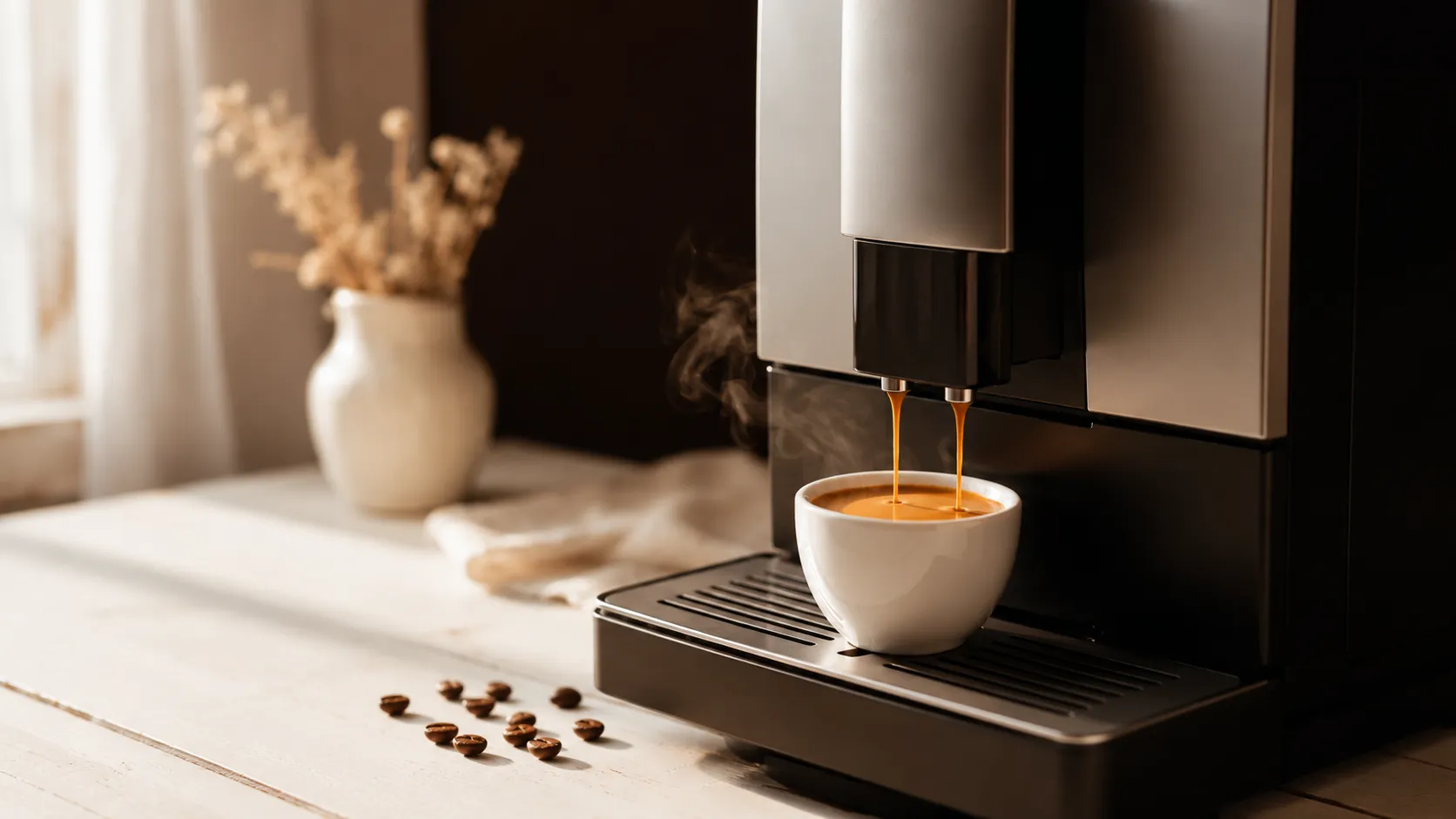
For any fully automatic espresso machine, start with a coffee from the CORE category: notes of chocolate, caramel, or nuts, moderate acidity, consistent body. It works without adjustments at the standard settings of any machine, from Philips LatteGo to DeLonghi Magnifica or Siemens EQ. EXPLORE and VISION coffees work in any machine too, but require calibration: increase the intensity by one level and adjust the grind one step coarser.
You bought the automatic espresso machine, set it up according to the instructions, and ordered the first coffee that looked interesting. The cup came out okay, but something was off. Maybe too sour. Maybe lacking body. Most of the time it's not the machine's fault and it's not the coffee's fault either: the default settings are calibrated for commercial coffees with a neutral profile, not for specialty coffee with more pronounced acidity or floral notes.
The further up the categories you go, the more you benefit from a manual setup with a separate grinder, where you can control every variable and the coffee expresses everything it has to offer.
Pe scurt
- CORE is the first choice for any fully automatic espresso machine: balanced profile, no adjustments needed.
- EXPLORE and VISION work in any automatic machine, but require calibration: increase the intensity and adjust the grind 1-2 steps coarser.
- The further up the categories you go, the more you gain from a manual setup with a separate grinder: that is where you extract the maximum from any coffee.
- For daily cappuccino and latte, CORE is the safe choice regardless of machine.
- Order 250g the first time you try any new category. Move to 1kg when you repeat.
What is an "automatic espresso machine"?
Before the recommendation, a clarification: there are two types of machines commonly called "espresso machines."
The fully automatic espresso machine (or superautomatic) grinds the beans, tamps the grounds, and extracts the espresso with a single button press. Philips LatteGo, DeLonghi Magnifica, Siemens EQ, and Jura are the most common in Romanian homes. You control the intensity and cup volume, but the grind and pressure remain within the parameters set by the manufacturer.
The semi-automatic espresso machine with a separate grinder (Breville Bambino, DeLonghi Dedica, prosumer machines) gives you full control over every variable: dose, tamping, grind, pressure. You can compensate for any characteristic of the coffee and extract the full potential from any bean.
The recommendations below are aimed primarily at fully automatic espresso machines, because that is where the choice of coffee and the initial settings matter most.
CORE coffees for automatic espresso machines
You start the machine at 7 in the morning and have less than 90 seconds until the first sip. You don't want to adjust anything. You want to know it will come out right regardless of the day.
Notes of dark chocolate, caramel, and nuts, consistent body, moderate acidity. Sometimes with a subtle sweetness of dried fruit in the finish. The profile is calibrated for wide extraction: it works at the standard settings of any automatic machine with no intervention whatsoever.
At the default settings, a CORE extracts correctly. The crema forms and holds for 30-40 seconds. The chocolate or caramel note from the description becomes recognizable in the cup, it doesn't stay in the background. If you make milk-based coffee, the sweetness remains present under the foam, the milk doesn't flatten it out.
EXPLORE in an automatic espresso machine
Yesterday's cup felt flat and you wanted something with more life in it. CORE was a good start, now you want to explore further.
EXPLORE coffees have fruity, citrus, or red fruit notes, more pronounced acidity, medium body. They work in filter and in semi-automatic espresso machines without adjustments. In fully automatic espresso machines they require one extra calibration step.
At the machine's default settings, the higher acidity can seem sharp over the first two or three cups. It's not a defect in the coffee: it's a mismatch between the profile and the default extraction parameters.
Adjust the grind one step coarser than your setting for CORE and increase the intensity by one level. After 3-4 cups: the acidity rounds out, the fruity notes become clearer, and the coffee gains body. In a cappuccino, the red fruit sweetness remains perceptible under the milk.
VISION in an automatic espresso machine
EXPLORE showed you that acidity can be pleasant in the cup. Now you want to know what a truly complex profile means.
VISION coffees have floral profiles, high acidity, notes of exotic or stone fruit. They work in any automatic espresso machine, including Philips LatteGo or DeLonghi Magnifica, but deliver everything they have to offer once calibrated. Machines with more flexible settings (Jura, Xelsis, Siemens EQ900) reach the result faster, but they are not the only ones capable.
At the default settings, the high acidity of a VISION can seem harsh and the floral notes get lost in the extraction. It's not the machine's fault: the complex profile reacts more sensitively to standard parameters than a CORE or EXPLORE would.
Order 250g the first time. Adjust the grind 1-2 steps coarser than your CORE setting and increase the intensity by one level. The first 3-4 cups are for calibration. After that: the acidity becomes bright rather than harsh, and the floral or fruity notes from the description start to be recognizable in the cup.
Quick guide: Guido coffee by machine type and taste preference
| Taste preference | Fully automatic espresso machine | Semi-automatic espresso machine | Moka pot |
|---|---|---|---|
| Chocolate, caramel, nuts | CORE - no adjustments | CORE or EXPLORE | CORE |
| Fruity or citrus notes | EXPLORE with calibration | EXPLORE | EXPLORE |
| Floral, complex | VISION with calibration | VISION | VISION with coarser grind |
| For daily cappuccino | CORE | CORE or EXPLORE | CORE |
Black espresso vs milk drinks
If you make more cappuccino, latte, or macchiato than black espresso, the logic for choosing a coffee is slightly different.
Milk tempers acidity and amplifies sweetness. An EXPLORE that seemed too bright in black espresso can work excellently in a cappuccino. The subtle floral notes of a VISION will be softened under milk, so VISION shows its quality best as a black espresso.
For daily cappuccino or latte: CORE or EXPLORE are safe choices. For day-to-day black espresso and you want to explore further: EXPLORE or VISION, depending on how much you enjoy fruity or floral notes.
First order: 250g or 1kg?
For any coffee you haven't tried yet, go with 250g. Once you open the bag, the coffee starts to oxidize. A 250g bag is finished in approximately 2-3 weeks at normal daily consumption, which means the last cup from the bag tastes the same as the first.
The 1kg bag makes sense once you know you want to repeat the same coffee and that you'll consume it within 4-6 weeks at most. The cost per gram is lower, but it's not worth it if you end up with half a bag that's three months old.
Guido coffees are at their best between 2 and 8 weeks from the roast date. Always check the roast date on the bag before ordering.
Once you've chosen the category, the next step is setting up your machine correctly. The automatic espresso machine setup guide explains what to adjust, in what order, and what to expect from the first extractions.