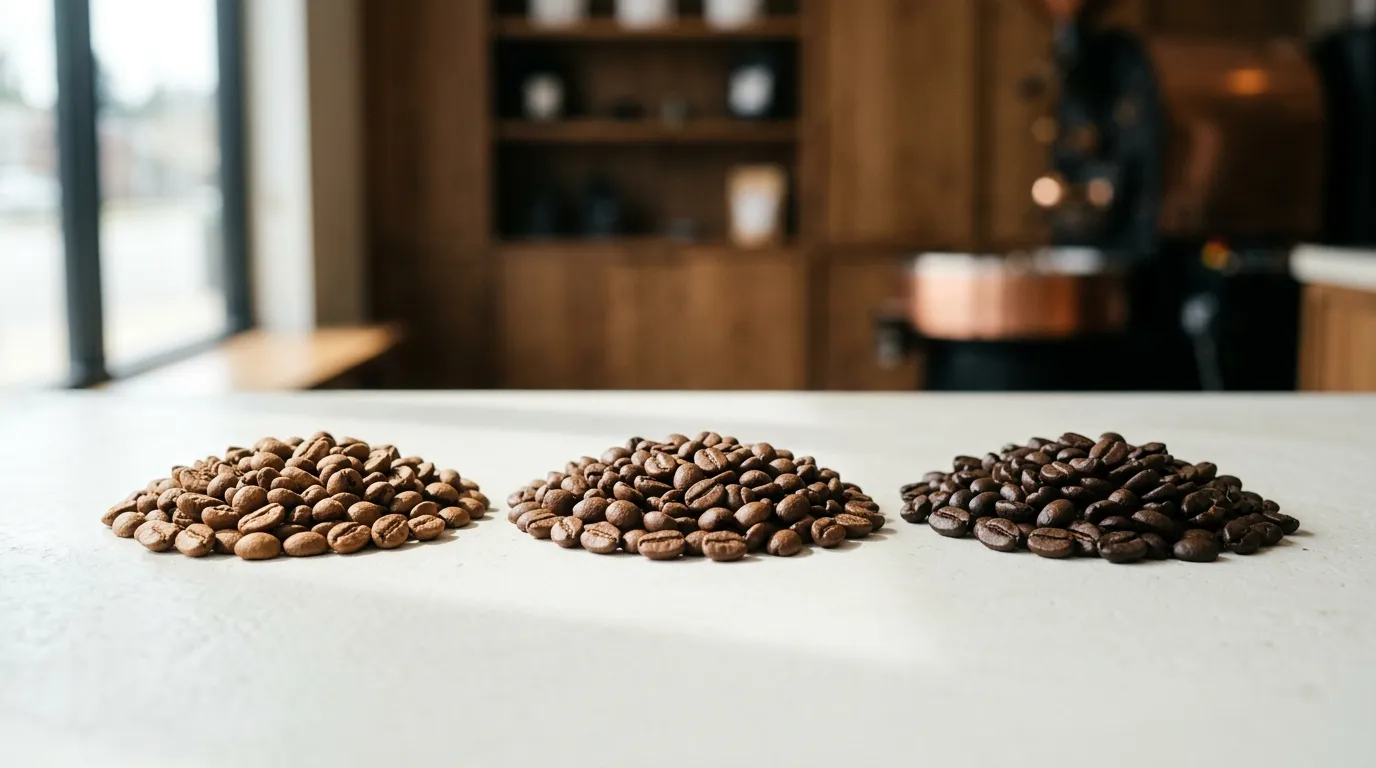
Have you ever wondered why two bags of coffee from the same region taste completely different? Or what the term omniroast means when you see it on a bag of Guido specialty coffee? The answer lies in the roast degree and roast profile.
Roasting is the bridge between the raw green bean and the final cup. During roasting, heat triggers the Maillard reaction and sugar caramelization, developing distinct aromatic profiles ranging from floral and citrusy to chocolatey and caramelly.
Pe scurt
- Roasting does not create flavors from nothing: it reveals and highlights potential already present in high-grade green coffee.
- Light roasting emphasizes acidity, floral, or fruity origin notes (found in Guido VISION lots).
- Medium roasting offers a balance between moderate acidity and caramelized sweetness (Guido CORE category).
- Omniroast means a profile developed to work across both filter methods (V60/Aeropress) and espresso.
- Avoid oily, black beans: surface oil indicates over-roasting that destroys origin characteristics.
What roast level means in specialty coffee
The roast level indicates how far the thermal process was taken in the roaster and the final bean temperature before cooling. In commercial coffee, dark roasting is often used to homogenize mixed lots and mask defects in lower-grade green coffee.
At the Guido roastery, roasting is structured into clear categories and profiles:
- CORE: Developed medium roast, balanced profile (chocolate, hazelnut, caramel), ideal for espresso and automatic machines.
- EXPLORE: Medium-light or omniroast, fruit-forward profile (yellow fruits, citrus), versatile across filter and espresso.
- VISION: Light roast or precise omniroast, complex floral/exotic profile, crafted for manual filter methods and acidity enthusiasts.
To understand general quality criteria and SCA scoring, check out our guide on what specialty coffee is.
Light roast: acidity and floral/fruity notes
Light roasting finishes shortly after the first crack. The beans exhibit a light brown shade, a matte dry surface, and no trace of oils.
Cup characteristics:
- Acidity: Bright, vivid, citric, or berry-like.
- Body: Thin to medium, delicate, tea-like structure.
- Aromatic profile: Floral notes (jasmine, bergamot), fresh fruit (peach, raspberry).
- Guido catalog example: Lots from the VISION category, such as Etiopia Lalesa (natural process, floral and nectarine notes).
- Recommended methods: V60, Chemex, Kalita Wave, Aeropress.
Trade-off to consider: Light roast requires precise grind size and quality water. In a basic automatic machine, light roast coffee can be hard to extract fully and may taste sharp or sour.
Medium roast: balance and sweetness
Medium roasting takes sugar development one step further. The beans take on a warm brown hue and become more soluble in water.
Cup characteristics:
- Acidity: Moderate, rounded, well-integrated.
- Body: Full, velvety, creamy.
- Aromatic profile: Milk chocolate, caramel, roasted hazelnuts, stone fruit.
- Guido catalog example: Lots from the CORE category, such as Columbia La Roma (washed process, chocolate and caramel).
- Recommended methods: Manual espresso machine, Moka pot, French Press, automatic espresso machine.
The medium roast profile is versatile and approachable for anyone moving from commercial coffee to specialty coffee. If you use an automatic coffee maker, see our guide on which Guido coffee to choose for automatic machines.
What omniroast coffee means
The term omniroast describes a modern roasting style where the roaster does not create separate profiles for "espresso" and "filter", but develops the bean to a point where it performs across both brewing methods.
An omniroast coffee like Etiopia Beshasha from the EXPLORE range is not a compromise. It requires high-density green coffee with rich natural sugars, roasted under strict thermal control to achieve high solubility for espresso without losing delicate volatile aromatics needed for filter brewing.
Advantages of omniroast coffee:
- Flexibility: Use the same bag for a morning V60 and an afternoon espresso.
- Clarity: Preserves origin identity better than a traditional dark espresso roast.
How to choose the roast level for your brew method
| Brew method | Guido roast level & category | What to expect |
|---|---|---|
| V60 / Chemex / Kalita | Light (VISION) or Omniroast (EXPLORE) | Aromatic clarity, fruity/floral notes, clean cup |
| Aeropress | Light, Medium, or Omniroast | Versatility depending on recipe and steep time |
| Manual espresso machine | Medium (CORE) or Omniroast (EXPLORE) | Rich crema, creamy body, balanced sweetness |
| Automatic espresso machine | Medium (CORE) | Even extraction without sharp acidity or oily beans |
| Moka Pot / Ibrik | Medium (CORE) | Intense, chocolatey flavor without burnt bitterness |
Explore our complete selection in the Guido coffee catalog on Boabe.ro, where every product details its category (CORE, EXPLORE, VISION), roast profile, and recommended brew methods.
How to recognize a bad roast
Not all commercial roasts succeed. Here are two common roasting defects to spot:
- Over-roasting (Dark/Burnt): Beans are dark and shiny, coated in surface oils. In the cup, the coffee tastes of ash, smoke, and persistent bitterness, stripping away terroir.
- Under-roasting (Underdeveloped/Baked): Beans were pulled too early or heat dropped during roasting. The coffee tastes of raw cereal, grass, and sour acidity.
Properly roasted specialty coffee always features matte beans, uniform color, and a clean, sweet cup.
These markers help narrow down your options before tasting. For balance and accessibility, look for medium or omniroast profiles in CORE. If you want to explore what the variety and processing contribute without the roast dominating, EXPLORE includes lots where the roast level is intentionally kept subordinate to the origin character.


